
First-Time Home Buyer in Alberta — Your Complete 2026 Guide
Written by Shawn Selanders | RECA-Licensed Mortgage Broker | 25+ Years Experience | Updated February 2026
Buying your first home is the biggest financial decision you'll ever make. It doesn't have to be the most stressful one.
This page walks you through everything — from how much you need for a down payment, to the government programs that put money back in your pocket, to what the entire process looks like start to finish. Written specifically for people buying in Alberta.
No bank jargon. No guesswork. Just the facts, from a broker who's helped thousands of Albertans buy their first home since 1999.
💰 The 2026 First-Time Buyer Advantage — Stack These Programs
As a couple buying your first home in 2026, you could access up to $200,000 in tax-advantaged down payment funds:
FHSA: $40,000 each × 2 = $80,000 (tax-free, no repayment)
Home Buyers' Plan: $60,000 each × 2 = $120,000 (tax-free from RRSP, repay over 15 years)
Plus: no land transfer tax in Alberta, up to $1,500 federal tax credit, possible GST rebate on new builds, and 30-year amortization now available. It has never been easier to structure your first purchase.

I've Done This a Few Thousand Times
I'm Shawn Selanders — an independent mortgage broker in Alberta since 1999. First-time buyers are my favourite clients to work with. You've never done this before. I've done it thousands of times. That's a good combination.
My job is to take the confusion out of it. I'll tell you exactly what you qualify for, which programs save you the most money, and walk you through every step from pre-approval to keys in your hand.
My service typically costs you nothing. The lender pays me a commission. You get expert guidance for free.
What's on This Page
- Do You Qualify as a First-Time Home Buyer?
- How Much Do You Need for a Down Payment?
- How Much Home Can You Actually Afford?
- Every Government Program Available to You in 2026
- The First Home Savings Account (FHSA) — Your Best Tool
- The Home Buyers' Plan (HBP) — $60,000 from Your RRSP
- Stacking FHSA + HBP — The Power Move
- First-Time Home Buyers' Tax Credit ($1,500)
- GST Rebate on New Builds
- Alberta-Specific Advantages (No Land Transfer Tax!)
- The Mortgage Stress Test — Explained Simply
- 30-Year Amortization — Now Available for First-Time Buyers
- Mortgage Default Insurance (CMHC) — What It Costs
- The Home-Buying Process — Step by Step
- Closing Costs Nobody Tells You About
- 10 Mistakes First-Time Buyers Make
- Frequently Asked Questions
- Talk to Shawn — Free Pre-Approval
1. Do You Qualify as a First-Time Home Buyer?
In Canada, the definition is more flexible than most people think:
You are a first-time home buyer if you (and your spouse or common-law partner) have not owned a home that you lived in during the current year or the previous four calendar years.
This means:
- You've never owned a home → you qualify
- You owned a home but sold it more than 4 years ago → you may qualify again
- You owned an investment property but never lived in it → you may still qualify
- Your spouse owned a home before you were together, but it was sold 4+ years ago → you may qualify
- You went through a separation and haven't owned/lived in a home for 4 years → you may qualify
Not sure if you qualify? It's not always obvious. Some programs define "first-time buyer" differently. I can sort it out in a 5-minute conversation. Don't assume you don't qualify — check first.
2. How Much Do You Need for a Down Payment?
In Canada, the minimum down payment depends on the purchase price:
| Purchase Price | Minimum Down Payment | Example |
|---|---|---|
| Up to $500,000 | 5% of purchase price | $450K home = $22,500 down |
| $500,001 to $1,499,999 | 5% of first $500K + 10% of the rest | $650K home = $40,000 down |
| $1,500,000 and above | 20% of purchase price | $1.5M home = $300,000 down |
Where Can Your Down Payment Come From?
- Personal savings (bank accounts, TFSA, non-registered investments)
- FHSA withdrawal (tax-free, no repayment required)
- RRSP under the Home Buyers' Plan (tax-free, repay over 15 years)
- Gifted funds from an immediate family member (parent, grandparent, sibling — lenders require a signed gift letter confirming no repayment is expected)
- Sale of another asset (car, investments, etc.)
- Down payment assistance programs (Attainable Homes Calgary, Liberty Home Ownership Program)
Borrowed money (credit cards, lines of credit, personal loans) generally cannot be used for a down payment. The lender will verify the source of your funds.
3. How Much Home Can You Actually Afford?
Two numbers matter when lenders decide how much mortgage you qualify for:
GDS Ratio (Gross Debt Service)
Your housing costs (mortgage + property tax + heating + half of condo fees) as a percentage of your gross income.
Target: 39% or less
TDS Ratio (Total Debt Service)
Your housing costs plus all other debts (car payment, student loans, credit card minimums) as a percentage of gross income.
Target: 44% or less
Quick Affordability Examples (5-year fixed at ~4%, 25-year amortization):
$70,000 household income → approximately $300,000–$340,000 purchase price
$100,000 household income → approximately $430,000–$490,000 purchase price
$130,000 household income → approximately $550,000–$630,000 purchase price
These are rough estimates. Your actual qualification depends on your credit score, existing debts, the specific rate, and the stress test. I can give you a precise number in about 15 minutes.
4. Every Government Program Available to You in 2026
Here's the complete list. Most first-time buyers don't realize how many programs they can stack together.
| Program | Benefit | Repayment? |
|---|---|---|
| FHSA (First Home Savings Account) | Save up to $40K tax-free for your down payment | No |
| Home Buyers' Plan (HBP) | Withdraw up to $60K from RRSP tax-free | Yes — 15 years |
| First-Time Home Buyers' Tax Credit | Up to $1,500 back at tax time | No |
| GST/HST New Housing Rebate | Up to $50,000 — GST eliminated on new builds up to $1M (Bill C-4, in effect March 2026) | No |
| 30-Year Amortization | Lower monthly payments (first-time buyers) | N/A |
| Attainable Homes Calgary | Buy with as little as $2,000 down | Shared appreciation |
| Liberty Home Ownership Program | Shared equity down payment assistance (Alberta-wide) | Shared appreciation |
Let's break down each one.
📊 Step One: Know Your Credit Score
Before you start shopping for a mortgage, find out where you stand. Borrowell lets you check your credit score for free in about 2 minutes — and it has zero impact on your score.
Check Your Score Free →5. The First Home Savings Account (FHSA) — Your Best Tool
If you're planning to buy within the next 1–15 years, this is the single most powerful savings tool available to you. It launched in April 2023, and too many people still don't know about it.
How the FHSA Works:
- Contribute up to $8,000 per year, to a lifetime maximum of $40,000
- Contributions are tax-deductible — just like an RRSP. If you earn $70,000 and contribute $8,000, your taxable income drops to $62,000.
- Withdrawals are tax-free when used to buy a qualifying home — just like a TFSA. You pay zero tax on the money you take out (including all investment growth).
- No repayment required — unlike the Home Buyers' Plan, you don't have to pay it back. It's yours.
- Unused room carries forward — up to $8,000 per year. So if you contribute $5,000 this year, you can contribute $11,000 next year.
- Couples can each have their own FHSA — that's up to $80,000 combined, tax-free.
- Account stays open for 15 years — or until you turn 71, whichever comes first. If you don't buy a home, the funds can be transferred to your RRSP tax-free.
My advice: Even if you're not buying for 3–5 years, open an FHSA now. Get your contribution room accumulating. You can invest inside the FHSA (stocks, ETFs, GICs) and grow that money tax-free. Every year you wait is $8,000 in lost contribution room. Open the account at any bank, credit union, or investment platform.
For full details, visit: Government of Canada — FHSA ↗
6. The Home Buyers' Plan (HBP) — $60,000 from Your RRSP
The HBP lets you borrow from your own RRSP — tax-free — to put toward your down payment.
How the HBP Works:
- Withdraw up to $60,000 per person from your RRSP (increased from $35,000 in April 2024)
- Couples can withdraw $120,000 combined
- No tax on the withdrawal — as long as you follow the rules
- Repay over 15 years — you put the money back into your RRSP in annual instalments (roughly 1/15th per year). If you miss a year, that amount gets added to your taxable income.
- 90-day rule: Your RRSP contributions must sit in the account for at least 90 days before you can withdraw them under the HBP
- Extended grace period: For withdrawals made between 2022–2025, repayment doesn't start until the 5th year after withdrawal (instead of the 2nd year)
- Must buy within the deadline: You need to purchase or build the qualifying home by October 1 of the year after your first withdrawal
For full details, visit: Government of Canada — Home Buyers' Plan ↗
7. Stacking FHSA + HBP — The Power Move
Here's what most people miss: you can use both programs on the same home purchase.
The Maximum Down Payment Stack (Per Couple):
Partner A FHSA: $40,000 (tax-free, no repayment)
Partner B FHSA: $40,000 (tax-free, no repayment)
Partner A HBP: $60,000 (tax-free from RRSP, repay over 15 years)
Partner B HBP: $60,000 (tax-free from RRSP, repay over 15 years)
Total: $200,000 in tax-advantaged funds toward your down payment.
Even individuals can access up to $100,000 ($40K FHSA + $60K HBP). Add investment growth inside the FHSA and you could be looking at even more.
Pro tip: You can also transfer money from your RRSP into your FHSA (up to FHSA limits). This "re-labels" the money — instead of having to repay it like HBP, the FHSA funds are free and clear. Ask your financial advisor about this strategy before making your withdrawal.
8. First-Time Home Buyers' Tax Credit — $1,500 Back
- Claim $10,000 on line 31270 of your tax return for the year you purchase your home
- At the 15% federal tax rate, this gives you a non-refundable tax credit of up to $1,500
- If buying with a spouse, you split the $10,000 claim between you (but it still totals $1,500 combined)
- Helps offset closing costs like legal fees, home inspection, and moving expenses
- You must not have owned a home in the year of purchase or the previous 4 years
This is automatic — you claim it on your tax return. No application needed.
9. GST Rebate on New Builds
If you're buying a newly built home or a substantially renovated home, you may be eligible for a GST rebate.
- The GST/HST New Housing Rebate can return up to 36% of the 5% GST paid, to a maximum rebate of approximately $6,300 on qualifying homes
- The home must be your primary residence
- Applies to new builds, substantially renovated homes, and homes purchased from a builder
- Resale homes are exempt from GST (no rebate because there's no GST charged)
- Alberta advantage: Alberta has no provincial sales tax (PST), so you're only dealing with 5% GST — not the 13% HST that Ontario buyers face
New in 2025/2026: The federal government has eliminated the 5% GST entirely for first-time buyers purchasing new builds priced at $1 million or under. If enacted, this could save buyers up to $50,000. Check with me for the latest status of this proposal — these things can change quickly with elections and new budgets.
10. Alberta-Specific Advantages — No Land Transfer Tax!
Here's why buying in Alberta is easier on your wallet than almost anywhere else in Canada:
Alberta vs. Other Provinces:
- No provincial land transfer tax. In Ontario, a first-time buyer purchasing a $500K home pays $2,475 in land transfer tax (after rebate). In Toronto, add another $2,475 in municipal tax. In Alberta? $0. You pay only modest title registration fees (typically $200–$400).
- No provincial sales tax. Alberta has no PST or HST — only the 5% federal GST applies to new builds. This saves you thousands compared to Ontario (13% HST) or B.C. (12% PST+GST on some purchases).
- More affordable home prices. The average home price in Calgary is significantly lower than Vancouver or Toronto. Your dollar goes further here.
- No provincial first-time buyer program — but Alberta compensates with lower overall costs. The province previously offered the PEAK program for low-income buyers, but it has been discontinued.
- Local programs: Attainable Homes Calgary helps buyers purchase homes at below-market prices with as little as $2,000 down. The Liberty Home Ownership Program offers shared-equity down payment assistance across Alberta. Edmonton's First Place Program defers land costs for 5 years on select developments.
11. The Mortgage Stress Test — Explained Simply
Every home buyer in Canada must pass the stress test. Here's what it is and why it exists.
What it is: The lender calculates whether you can afford your mortgage at a rate higher than the one you're actually getting. You must qualify at the greater of: your contract rate + 2%, or 5.25% — whichever is higher.
Example: If your actual mortgage rate is 4.0%, the stress test qualifies you at 6.0% (4.0% + 2%). This means your approved mortgage amount will be lower than what the actual payments would suggest.
Why it exists: It's designed to protect you. If rates rise during your term or at renewal, you'll still be able to afford your payments. It was introduced in 2018 to prevent Canadians from overextending.
The impact: The stress test typically reduces your purchasing power by about 15–20%. If you could afford a $500K home based on actual rates, the stress test might qualify you for $410K–$425K. This is frustrating, but it's the reality for every buyer in Canada.
12. 30-Year Amortization — Now Available for First-Time Buyers
Previously, insured mortgages (less than 20% down) were capped at a 25-year amortization. That's changed.
What's new: First-time home buyers can now get a 30-year amortization on insured mortgages — even with less than 20% down.
The benefit: Spreading payments over 30 years instead of 25 lowers your monthly payment. On a $400,000 mortgage at 4%, the difference is roughly $200/month less.
The trade-off: You pay more interest over the life of the mortgage. A 30-year amortization means 5 more years of interest payments. On a $400K mortgage at 4%, that's approximately $35,000–$40,000 more in total interest.
My take: The 30-year amortization is a great option if the lower payment helps you qualify for the home you want, or if cash flow is tight in the early years. You can always make prepayments or switch to accelerated payments later to pay it off faster. It's a tool — use it strategically.
13. Mortgage Default Insurance (CMHC) — What It Costs
If your down payment is less than 20%, you're required to purchase mortgage default insurance (often called CMHC insurance, though it's also provided by Sagen and Canada Guaranty).
Insurance Premium Rates:
| Down Payment | Premium (% of mortgage) | Example on $450K home |
|---|---|---|
| 5% ($22,500) | 4.00% | $17,100 premium |
| 10% ($45,000) | 3.10% | $12,555 premium |
| 15% ($67,500) | 2.80% | $10,710 premium |
| 20%+ | Not required | $0 |
The premium is typically added to your mortgage balance and paid off over the life of the mortgage. You don't need to come up with it in cash at closing. The insurance protects the lender, not you — but it's what allows you to buy with less than 20% down.
14. The Home-Buying Process — Step by Step
Step 1: Get Pre-Approved (Call Shawn — 15 minutes)
Before you look at a single house, get pre-approved. This tells you exactly how much you qualify for, locks in a rate for up to 120 days, and shows sellers you're a serious buyer. Your Realtor won't write offers without one. I can usually have your pre-approval done in a day.
Step 2: Find a Realtor
Work with a Realtor who knows your target area. They'll set up MLS searches, book showings, and guide you through making an offer. I can recommend trusted Realtors in Calgary, Okotoks, and surrounding communities if you need one.
Step 3: House Hunt
With your pre-approval in hand, you know your budget. Stick to it. Look at homes, attend open houses, and when you find the right one — you're ready to move fast.
Step 4: Make an Offer
Your Realtor prepares the purchase contract. Include conditions for financing, home inspection, and any other protections you need. The seller accepts, counters, or rejects. Once you have an accepted offer with conditions, the clock starts.
Step 5: Finalize Your Mortgage
Send me the signed purchase contract. I submit your full application to the lender. They'll order an appraisal (if required), verify your documents, and issue a formal approval. I handle all of this — you just provide the paperwork I ask for.
Step 6: Home Inspection
Hire a certified home inspector ($400–$600). They'll check the structure, roof, plumbing, electrical, foundation, and more. If major issues are found, you can renegotiate, request repairs, or walk away (if your offer has an inspection condition).
Step 7: Remove Conditions
Once financing is approved and the inspection is satisfactory, your Realtor removes the conditions. The deal is now firm. This is the point of no return — your deposit becomes non-refundable.
Step 8: Hire a Lawyer
Your real estate lawyer handles the title search, prepares the mortgage documents, transfers the land title, and ensures the funds flow correctly on closing day. Budget $1,200–$2,000 for legal fees (including disbursements).
Step 9: Closing Day 🎉
Your lawyer receives the mortgage funds from the lender, pays the seller, and registers the title in your name. You get the keys. You're a homeowner. Congratulations — you earned this.
15. Closing Costs Nobody Tells You About
Your down payment isn't your only upfront cost. Budget for these too:
- Legal fees: $1,200–$2,000 (lawyer fees + disbursements + title insurance)
- Home inspection: $400–$600
- Appraisal fee: $0–$500 (often covered by the lender, sometimes not)
- Title registration: $200–$400 (Alberta Land Titles Office)
- Property tax adjustment: If the seller has prepaid taxes, you reimburse them for the portion covering the days after you take possession
- Home insurance: Required before closing — lender needs proof of insurance before they'll fund. Budget $1,200–$2,500/year.
- Moving costs: $500–$2,000+ depending on distance and whether you hire movers
- Utility hookups/transfers: Minimal but worth noting — electricity, gas, water, internet
- GST (new builds only): 5% on the purchase price. Often included in the listed price but confirm with your builder.
💡 Rule of Thumb: Budget 1.5% to 3% of the Purchase Price for Closing Costs
On a $450,000 home, that's approximately $6,750 to $13,500 in cash you'll need in addition to your down payment. This catches many first-time buyers off guard. Plan for it now.
16. 10 Mistakes First-Time Buyers Make
I've seen all of these. More than once. Learn from other people's mistakes.
1. Not getting pre-approved first. You end up falling in love with a home you can't afford. Or worse, you can afford it but lose it to another buyer who was already pre-approved and moved faster.
2. Only talking to your bank. Your bank offers their products and their rates. A broker shops 20+ lenders. The difference can be thousands of dollars over your term.
3. Not opening an FHSA early enough. Contribution room only starts accumulating after you open the account. Every year you wait is $8,000 in lost room. Open it now, even if you're not buying for years.
4. Forgetting about closing costs. Your down payment is not your only cost. Budget 1.5–3% of the purchase price for legal fees, inspection, insurance, and other closing expenses.
5. Making major financial changes before closing. Don't switch jobs, take on new debt, buy a car, or co-sign a loan between your pre-approval and closing day. The lender checks again before funding, and changes can kill your approval.
6. Skipping the home inspection. "It looks fine" is not a structural assessment. A $500 inspection can save you from a $30,000 foundation problem. Always. Get. The. Inspection.
7. Maxing out your budget. Just because you qualify for $500K doesn't mean you should spend $500K. Leave room for life — unexpected repairs, rate increases at renewal, changes in income. Comfortable beats maxed out every time.
8. Ignoring the mortgage features. The lowest rate isn't always the best mortgage. Prepayment privileges, portability, and penalty structure matter — especially if your life might change in the next 5 years.
9. Not budgeting for homeownership costs. Property taxes, utilities, maintenance, insurance — these are ongoing costs that renters don't think about. Budget $200–$400/month on top of your mortgage for upkeep.
10. Waiting for the "perfect" time. There is no perfect time. There's never been a year when people weren't saying "I should wait." The best time to buy is when you can afford it and you find the right home. Real estate is a long game.
17. Frequently Asked Questions
Q: What credit score do I need to buy a home?
A: Most lenders require a minimum credit score of 600–640 for insured mortgages. A score of 680+ will give you access to the most competitive rates and widest lender selection. Below 600? We still have options, but they're more limited and rates will be higher. Check your credit score for free here ↗
Q: Can I use a gifted down payment?
A: Yes — from an immediate family member (parent, grandparent, sibling). The family member must provide a signed gift letter confirming the money is a gift and does not need to be repaid. No, it cannot be a loan from a friend or an unsigned transfer.
Q: How long does the whole process take?
A: From pre-approval to closing, typically 30–90 days depending on how quickly you find a home. The pre-approval itself takes 1–2 days. Once you have an accepted offer, financing approval usually takes 3–7 business days. The legal closing process takes 2–4 weeks.
Q: Can I buy a home if I'm self-employed?
A: Yes, but it's more complex. Most lenders want to see 2 years of tax returns (T1 General, Notice of Assessment) showing consistent income. Some lenders offer stated-income programs for self-employed borrowers. This is where having a broker is especially valuable — I know which lenders are friendly to self-employed buyers.
Q: Can I buy a home as a newcomer to Canada?
A: Yes. CMHC, Sagen, and Canada Guaranty all offer newcomer programs with as little as 5% down. You'll typically need valid immigration status (permanent resident card or work permit), proof of income, and 90 days of Canadian credit history. Some lenders are more newcomer-friendly than others — I'll point you to the right one.
Q: Should I buy a condo or a house?
A: Depends on your budget and lifestyle. Condos are often more affordable but come with monthly condo fees ($200–$600+) that don't build equity. Houses give you more space and control but cost more. In Calgary, condos can be a great entry point. In Okotoks or High River, you may find a townhouse or starter home within a similar budget.
Q: Does using a mortgage broker cost me anything?
A: No. My service is completely free to you. The lender pays the broker fee when your mortgage funds. You get expert guidance, access to 20+ lenders, rate negotiation, and someone managing the process from start to finish — at no cost.
Q: How much income do I need to buy a $450,000 home?
A: With 5% down, a 25-year amortization, and current rates around 4%, you'd need a household income of approximately $95,000–$110,000 (assuming minimal other debts). A 30-year amortization lowers the income requirement. These numbers vary based on your specific debts, rate, and down payment. I can give you an exact answer in 15 minutes.
18. Talk to Shawn — Free Pre-Approval
You've done the research. You've read the guide. Now let's make it real.
Here's what happens when you call me:
- I'll tell you exactly how much you qualify for — in 15 minutes
- I'll identify which programs you can stack (FHSA, HBP, tax credit, GST rebate)
- I'll lock in a rate hold for up to 120 days — protecting you while you shop
- I'll map out your down payment and closing costs so there are zero surprises
- I'll recommend trusted Realtors, inspectors, and lawyers if you need them
- I'll be with you every step — from pre-approval to keys in your hand
Ready to Buy Your First Home? Let's Talk.
No pressure. No obligation. Just a straight conversation about what you can afford and how to get there.
Want to keep this information?
📥 Download the Free Guide (PDF)Call/Text: 403-703-6847
Email: Shawn@ShawnSelanders.ca
Office: 614 High View Park NW, High River, AB T1V 1E5
Hours: Monday to Friday: 9:00 – 7:00 | Saturday & Sunday: 12:00 – 5:00
Helping first-time buyers across Alberta, including:
📊 Check Your Credit Score For Free Before You Start
Know where you stand. Free, fast, and it won't hurt your score.
Click For a Free Credit Check ↗📱 Download My Mortgage App — Calculators, Rates & More
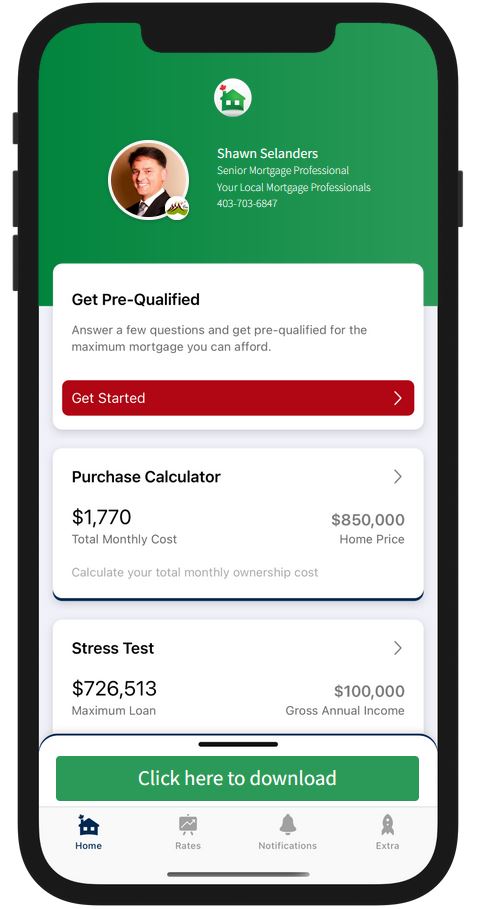
Affordability calculators, stress test tools, real-time rates from 20+ lenders, and land transfer tax comparisons — all free, right on your phone.


More on My Website
Shawn Selanders — RECA-licensed mortgage broker
Your Local Mortgage Professionals — Independent Mortgage Professional
Serving Calgary, Okotoks, High River, and all of Alberta since 1999
This page is for informational purposes only and does not constitute financial advice. Programs, rates, terms, and eligibility criteria are subject to change. Always verify current program details with the relevant government agency or your mortgage broker. O.A.C. E.&O.E.
📊 Run the Numbers Yourself
Use my free mortgage calculators to estimate payments, closing costs, affordability, and more — before you talk to any lender.
Open Mortgage Calculators →