
Mortgage Pre-Approval in Alberta — What It Is, Why It Matters, and How to Get Yours
Written by Shawn Selanders | RECA-Licensed Mortgage Broker | 25+ Years Experience | Updated February 2026
If you're buying a home in Alberta, this is where the journey starts.
A mortgage pre-approval tells you exactly how much you can afford, locks in a rate for up to 120 days, and gives you the confidence to shop for a home knowing you can actually close the deal.
Without one, you're guessing. With one, you're in control. It takes about 15 minutes to get started — and it costs you nothing.
⚡ Get Pre-Approved — It's Free, Fast, and It Locks In Your Rate
I can have your pre-approval done in as little as 24 hours. One phone call. A few documents. And you'll know exactly where you stand — how much you qualify for, what your payments will be, and which rate you're locked in at. No cost, no obligation.

Why Get Pre-Approved With a Broker?
When you go to your bank for a pre-approval, they check one thing: their rates. When you come to me, I check 40+ lenders — banks, credit unions, monoline lenders, and alternative lenders — and find the best rate and best mortgage for your situation.
I've been doing this since 1999. I know which lenders are strict, which are flexible, which love self-employed borrowers, and which give first-time buyers the best deal. That knowledge is free to you.
The lender pays my fee. You pay nothing.
What's on This Page
- What Is a Mortgage Pre-Approval?
- Pre-Approval vs. Pre-Qualification — What's the Difference?
- 7 Reasons You Need a Pre-Approval Before House Hunting
- What Lenders Look At — The 5 Pillars
- Documents You'll Need — The Complete Checklist
- The Pre-Approval Process With Me — Step by Step
- The 120-Day Rate Hold — Your Secret Weapon
- Credit Scores — What You Need and How to Improve
- What If You Get Denied? (It's Not the End)
- 8 Things NOT to Do After Getting Pre-Approved
- Frequently Asked Questions
- Get Pre-Approved Now — Free
1. What Is a Mortgage Pre-Approval?
A mortgage pre-approval is a lender's written statement that says: "Based on your income, credit, and financial situation, we're prepared to lend you up to $X at Y% interest rate, subject to conditions."
It's not a guarantee — the lender still needs to approve the specific property you buy and verify your information at the time of purchase. But it's the closest thing to a guarantee you can get before you find a home.
What a Pre-Approval Tells You:
- Maximum purchase price — the most you can spend on a home
- Maximum mortgage amount — how much the lender will lend you
- Interest rate — locked in for up to 120 days
- Estimated monthly payment — so you can budget with confidence
- Any conditions — things you need to address (debts to pay off, documentation needed, etc.)
- Any potential issues — credit problems, income gaps, or other flags that could affect final approval
2. Pre-Approval vs. Pre-Qualification — What's the Difference?
These terms get used interchangeably, but they're not the same thing.
Pre-Qualification
- Quick estimate based on self-reported information
- No credit check
- No document verification
- No rate hold
- Takes 5–10 minutes
- Carries little weight with sellers and Realtors
Pre-Approval ✅
- Thorough assessment based on verified documents
- Full credit check
- Income and assets verified
- Rate locked for up to 120 days
- Takes 1–2 days (start to finish)
- Gives you credibility with sellers and Realtors
Bottom line: A pre-qualification is a rough guess. A pre-approval is a real commitment from a real lender with a real rate hold. If you're serious about buying, get the pre-approval. It's what Realtors expect, and it's what gives you an edge in a competitive market.
3. 7 Reasons You Need a Pre-Approval Before House Hunting
1. You'll know your exact budget. No guessing, no online calculators, no "I think we can afford..." You'll have a number from an actual lender based on your actual finances.
2. You lock in your rate. The pre-approval comes with a rate hold — typically 120 days. If rates go up while you're house hunting, you're protected. If they go down, you get the lower rate. You can't lose.
3. Sellers take you seriously. When your Realtor submits an offer and says "this buyer is pre-approved," the seller knows the deal is likely to close. In a competitive situation, that can be the difference between winning and losing the home.
4. You catch problems early. A pre-approval surfaces any issues — credit score too low, debts too high, income documentation gaps — before you're in the middle of a time-sensitive purchase. This gives you time to fix problems instead of scrambling.
5. You save time. Instead of looking at homes outside your budget (and getting emotionally attached to ones you can't afford), you focus your search on homes that are actually within reach.
6. You can move fast. In Alberta's market, good homes go quickly. If you're already pre-approved, you can write an offer the same day you see the home. Buyers without pre-approval lose deals because they can't move fast enough.
7. It's completely free. A pre-approval through a mortgage broker costs you nothing. There is no fee, no obligation, and no commitment to proceed. The only cost of not getting one is the money and opportunities you miss.
4. What Lenders Look At — The 5 Pillars
Every lender evaluates the same five things. Understanding them puts you in a stronger position.
Pillar 1: Income
How much do you earn, and how stable is it? Lenders want to see consistent, verifiable income. Salaried employment is the easiest to verify. Self-employed, commission-based, and contract income require more documentation (usually 2 years of tax returns). Both full-time and part-time income count — overtime and bonuses may count too, depending on the lender.
Pillar 2: Credit
Your credit score tells lenders how reliably you pay your debts. Most A-lenders require a minimum of 640–680. A score of 700+ gets you access to the best rates. Below 600? You may still qualify with a B-lender or alternative lender, but expect higher rates. Your credit report also shows your payment history, credit utilization, and any collections or bankruptcies.
Pillar 3: Down Payment
How much cash you're putting in. Minimum is 5% for homes under $500K (with higher requirements above that). The lender will verify the source of your down payment — it must be documented. Savings, FHSA, RRSP (via HBP), gifted funds, and proceeds from the sale of another asset are all acceptable. Borrowed money (credit cards, unsecured loans) is generally not.
Pillar 4: Debt Service Ratios
Lenders use two formulas to assess your ability to carry the mortgage:
GDS (Gross Debt Service): Housing costs ÷ gross income. Target: ≤ 39%
TDS (Total Debt Service): Housing costs + all other debts ÷ gross income. Target: ≤ 44%
If your ratios are too high, it means you have too much debt relative to your income. Paying down credit cards, car loans, or student loans before your pre-approval can significantly increase how much you qualify for.
Pillar 5: The Property
This comes into play at final approval (not pre-approval), but it's worth noting: the lender must be satisfied that the property you're buying is worth what you're paying for it. They may order an appraisal. They'll also check property type (detached, condo, mobile home), location, and condition. Some property types are harder to finance than others.
5. Documents You'll Need — The Complete Checklist
Have these ready and the process moves fast. Missing documents = delays.
📋 For Everyone:
- ☐ Government-issued photo ID (driver's licence, passport)
- ☐ Social Insurance Number (SIN)
- ☐ Current address and length of time there
- ☐ Marital status and number of dependents
💼 If You're Employed:
- ☐ Most recent pay stub (within 30 days)
- ☐ Letter of employment (on company letterhead — confirming position, salary, start date, and employment type)
- ☐ T4 slips (past 2 years)
- ☐ Notice of Assessment (past 2 years) — from CRA after filing your taxes
🏢 If You're Self-Employed:
- ☐ T1 Generals (personal tax returns — past 2 years)
- ☐ Notice of Assessment (past 2 years)
- ☐ Financial statements or T2 (if incorporated)
- ☐ Business licence (if applicable)
- ☐ 3 months of business bank statements (some lenders)
💰 Down Payment and Assets:
- ☐ 90 days of bank statements showing your down payment savings
- ☐ RRSP and/or FHSA statements (if using for down payment)
- ☐ TFSA or investment statements (if applicable)
- ☐ Gift letter (if any portion is a gift — signed by donor, confirming no repayment)
📊 Debts and Obligations:
- ☐ Most recent statements for all debts: credit cards, car loans, student loans, lines of credit
- ☐ Current mortgage statement (if you already own a property)
- ☐ Child or spousal support obligations (if applicable)
- ☐ Property tax amount (if you own a property)
- ☐ Condo fees (if applicable)
Don't worry if you're missing something. I'll tell you exactly what I need. Most people don't have everything perfectly organized — that's normal. We work through it together.
6. The Pre-Approval Process With Me — Step by Step
Step 1: Quick Conversation (10–15 minutes)
Call, text, or email me. I'll ask a few questions about your income, down payment, and what you're looking to buy. Within minutes, I can give you a rough idea of what you'll qualify for.
Step 2: Submit Your Application
You can apply online through my website, through my mortgage app, or I'll walk you through it over the phone. I'll tell you exactly which documents to gather.
Step 3: I Pull Your Credit and Run the Numbers
With your permission, I'll check your credit score and calculate your debt service ratios. This tells me exactly where you stand and which lenders are the best fit.
Step 4: I Shop 40+ Lenders
I compare rates, features, and qualification criteria across banks, credit unions, monoline lenders, and alternative lenders. I find the best match — not just the lowest rate, but the right mortgage for your situation.
Step 5: You Get Your Pre-Approval
I provide you with your pre-approved amount, your locked-in rate (for up to 120 days), your estimated monthly payment, and a clear picture of what comes next. You're ready to shop for a home with confidence.
Total time from start to pre-approval letter: typically 24–48 hours. Sometimes same day if your documents are ready.
7. The 120-Day Rate Hold — Your Secret Weapon
This is one of the most valuable and least understood benefits of getting pre-approved.
How It Works:
- When I secure your pre-approval, the lender locks in your rate for 120 days (4 months). Some lenders hold even longer.
- If rates go up during those 120 days → you keep the lower locked-in rate. You're protected.
- If rates go down during those 120 days → you get the lower rate instead. You win either way.
- There is no cost for a rate hold. No obligation. You can still change lenders or decide not to buy.
- If your 120 days are about to expire and you haven't found a home, I can often renew the rate hold with a fresh application.
Think of it this way: Every day you're house hunting without a rate hold, you're exposed to rate increases. A 0.25% rate hike on a $400,000 mortgage costs you $2,940 over a 5-year term. The rate hold costs you $0. There is no reason not to have one.
8. Credit Scores — What You Need and How to Improve
Credit Score Ranges and What They Mean for Your Mortgage:
760+ (Excellent): Best rates available. Every lender wants your business.
700–759 (Very Good): Access to most lenders and competitive rates.
680–699 (Good): Qualifies with most A-lenders. May miss the absolute best rates.
640–679 (Fair): Some A-lenders will work with you. May need to explore credit unions or monoline lenders.
600–639 (Below Average): Limited A-lender options. B-lenders become the primary option. Higher rates.
Below 600 (Poor): Alternative and private lenders only. Significantly higher rates. May require larger down payment.
5 Ways to Improve Your Score Before Applying:
- Pay all bills on time. Even one missed payment can drop your score significantly. Set up auto-pay for everything.
- Keep credit card balances below 30% of your limit. Maxing out cards hurts your score. If your limit is $10,000, keep the balance under $3,000.
- Don't close old credit cards. Length of credit history matters. That credit card you've had since college? Keep it open (even if you don't use it much).
- Don't apply for new credit. Every application triggers a hard inquiry. Multiple inquiries in a short period signal risk. Avoid opening new cards or loans before your mortgage application.
- Check your report for errors. Mistakes happen. A wrong address, a debt that isn't yours, or a missed payment that was actually paid on time — all can be disputed and corrected.
Don't know your score? Check it for free: Free Credit Check via Borrowell ↗
9. What If You Get Denied? (It's Not the End)
Getting denied is not uncommon, and it's not permanent. Here are the most common reasons — and what to do about each one.
Credit score too low:
Fix: Pay down balances, bring overdue accounts current, dispute errors on your report. Most people can improve their score by 50–100 points in 3–6 months with focused effort.
Debt ratios too high:
Fix: Pay off a credit card, pay down a car loan, or reduce your target purchase price. Sometimes paying off just $5,000 in debt changes everything.
Income not high enough or not verifiable:
Fix: If self-employed, work with your accountant to optimize your declared income. If recently employed, wait until your probation period ends. If income is just short, consider adding a co-signer or co-borrower.
Down payment source issues:
Fix: Lenders need a clear paper trail. Large cash deposits, undocumented transfers, or money that appeared recently without explanation will be flagged. Keep clean records of where your money comes from.
Recent job change:
Fix: If you're in a probationary period, some lenders won't count your income. Wait until probation ends, or find a lender that's more flexible. I know which ones are.
This is where a broker shines. If one lender says no, I have 39 others to try. Different lenders have different criteria. What fails at a bank might fly at a credit union or monoline lender. I've gotten approvals for clients who were turned down elsewhere — many times.
10. 8 Things NOT to Do After Getting Pre-Approved
Your pre-approval is based on a snapshot of your finances at a specific moment. Change anything, and the approval can be revoked. The lender checks again before funding. Here's what to avoid:
- Don't switch jobs — even to a higher-paying one. Lenders want stability. If you must change jobs, call me first.
- Don't buy a car — a new car loan changes your debt ratios and could kill your approval.
- Don't open new credit cards — every application triggers a hard inquiry and adds potential debt.
- Don't co-sign for anyone — co-signing adds their debt to your ratios. Even if they're the one paying.
- Don't make large deposits without a paper trail — unexplained deposits look like undisclosed debt to the lender.
- Don't max out your credit cards — keep balances where they were (or lower) at the time of pre-approval.
- Don't miss any payments — a single late payment can drop your credit score enough to disqualify you.
- Don't make big lifestyle changes — moving, going part-time, starting a business — keep everything stable until closing day.
The rule: From pre-approval to closing day, keep your financial life as boring as possible. No surprises. Your future self will thank you.
11. Frequently Asked Questions
Q: Does getting pre-approved hurt my credit score?
A: It involves a credit check (hard inquiry), which may cause a minor, temporary dip of a few points. This recovers quickly and is completely normal — every home buyer goes through it. One mortgage inquiry won't meaningfully affect your score.
Q: How long does a pre-approval last?
A: Typically 90–120 days, depending on the lender. If it expires before you find a home, I can renew it with a fresh application. Your rate hold may update to the current rate (or remain the same if rates haven't changed).
Q: Can I get pre-approved without a down payment saved yet?
A: You can get a preliminary assessment, but a formal pre-approval requires proof that your down payment exists (or will exist by closing). If you're still saving, I can tell you exactly how much you need and help you plan.
Q: Does a pre-approval guarantee I'll get the mortgage?
A: No. A pre-approval is a conditional commitment. The lender still needs to approve the specific property (via appraisal if required) and verify that your financial situation hasn't changed. But in practice, if nothing changes between pre-approval and final application, approval is almost always straightforward.
Q: Can I get pre-approved with multiple lenders?
A: You can, but each one triggers a separate credit inquiry. When you work with me, I do one credit check and shop your application to 40+ lenders. One check, dozens of options. That's the broker advantage.
Q: I'm a newcomer to Canada. Can I get pre-approved?
A: Yes. Several lenders offer newcomer programs for permanent residents and those with valid work permits. You'll typically need 90 days of Canadian credit history, proof of income, and valid immigration documentation. I work with newcomer clients regularly and know which lenders have the best programs.
Q: Should I get pre-approved before I talk to a Realtor?
A: Yes. Most experienced Realtors won't take you house hunting until you have a pre-approval. It shows you're a serious buyer and it tells them your budget. This is step one — always.
12. Get Pre-Approved Now — Free
You could keep reading about mortgages. Or you could pick up the phone, get your pre-approval done in 24 hours, and start shopping for a home this weekend.
One Call. 15 Minutes. You'll Know Where You Stand.
I'll tell you how much you qualify for, what rate I can lock in, and what comes next. Free, fast, no pressure.
Call/Text: 403-703-6847
Email: ShawnSelanders@gmail.com
Office: 614 High View Park NW, High River, AB T1V 1E5
Hours: Monday to Friday: 9:00 – 7:00 | Saturday & Sunday: 12:00 – 5:00
Pre-approving home buyers across Alberta, including:
📊 Check Your Credit Score Before You Apply
Know where you stand before we talk. Free, fast, and it won't affect your score.
Click For a Free Credit Check ↗📱 Download My Mortgage App — Start Your Pre-Approval From Your Phone
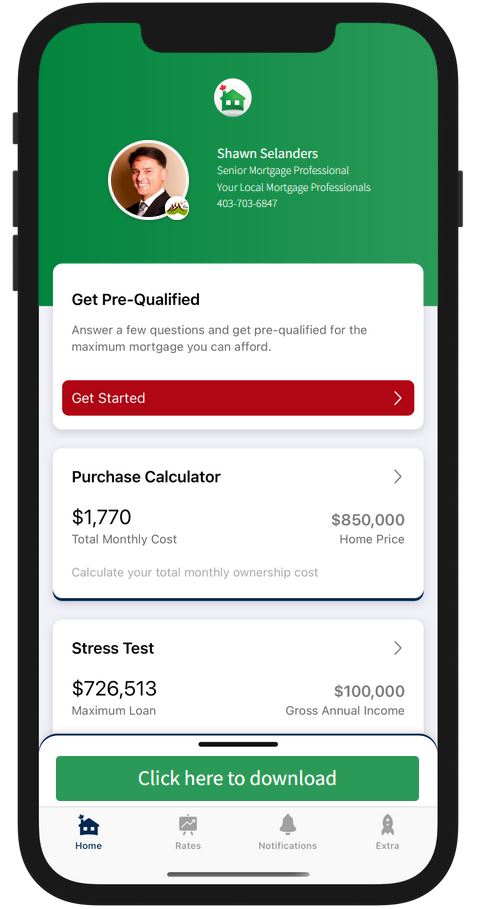
Affordability calculators, real-time rates, stress test tools, and the ability to start your application — right from your phone.


Related Guides on My Website
Shawn Selanders — RECA-licensed mortgage broker
Your Local Mortgage Professionals — Independent Mortgage Professional
Serving Calgary, Okotoks, High River, and all of Alberta since 1999
This page is for informational purposes only and does not constitute financial advice. Pre-approval is subject to lender conditions and is not a guarantee of final mortgage approval. Rates, terms, and eligibility criteria are subject to change. O.A.C. E.&O.E.