
Self-Employed Mortgage in Alberta — How to Get Approved When You're Your Own Boss
Written by Shawn Selanders | RECA-Licensed Mortgage Broker | 25+ Years Experience | Updated February 2026
You built a business. You earn good money. And then the bank says "no" because your tax return doesn't look the way they want it to.
Sound familiar? You're not alone. Nearly 20% of Canadians are self-employed — that's over 2.6 million people — and getting a mortgage is harder for every single one of them. Not because they can't afford it. Because the system wasn't built for them.
I've been helping self-employed Albertans get mortgages since 1999. I know which lenders say yes, which programs fit, and how to present your income so it works. This page gives you the full picture.
🎯 The Self-Employed Mortgage Problem in One Sentence
You write off expenses to reduce your taxes (smart business). But those write-offs reduce your declared income. And lenders use your declared income to decide how much mortgage you qualify for. The better you are at reducing your tax bill, the harder it is to get a mortgage. There are solutions — that's what this page is about.

Why Self-Employed Clients Come to Me
Your bank looks at one thing: their own products, their own rules. When a self-employed file doesn't fit their box, they say no. That's not the end of the story — it's the beginning of mine.
I have access to 20+ lenders — A-lenders, B-lenders, credit unions, monoline lenders, and alternative lenders — each with different criteria for self-employed borrowers. Where one says no, another says yes. I've been matching self-employed clients with the right lender for 25 years.
My service is free to you. The lender pays my fee. You get expert guidance at no cost.
What's on This Page
- Who Counts as "Self-Employed" to a Lender?
- Why It's Harder — The Write-Off Trap
- 3 Ways Lenders Verify Self-Employed Income
- Business Structure Matters — Sole Proprietor vs. Incorporated
- A-Lenders, B-Lenders, and Private Lenders — What's the Difference?
- Stated Income Programs — When Your Tax Return Doesn't Tell the Full Story
- Down Payment Requirements for Self-Employed Borrowers
- Documents You'll Need — The Complete Checklist
- 7 Strategies to Maximize Your Approval
- Real-World Scenarios — Alberta Self-Employed Buyers
- 6 Mistakes Self-Employed Buyers Make
- Frequently Asked Questions
- Talk to Shawn — Free Consultation
1. Who Counts as "Self-Employed" to a Lender?
Lenders define "self-employed" more broadly than most people think. You're classified as self-employed if you fall into any of these categories:
- Sole proprietor — you run a business under your own name or a registered business name
- Incorporated business owner — you own and operate a corporation
- Partnership — you own a portion of a business with one or more partners
- Freelancer or independent contractor — you work project-to-project without a single employer
- Commission-based earner — real estate agents, insurance agents, salespeople (even with a "home" brokerage)
- Gig worker or contract worker — you receive T4A slips rather than T4s
- Farmer or rancher — agricultural self-employment is common in Alberta
The key distinction: if you don't receive a regular T4 paycheque from an employer, lenders will likely treat you as self-employed — even if your income is high and consistent.
Grey area: Some people are both employed and self-employed (e.g., a nurse with a side business, or a teacher who does consulting in the summer). This can actually work in your favour — I can use both income streams to qualify you. Let's talk about your specific situation.
2. Why It's Harder — The Write-Off Trap
Here's the fundamental problem, and it affects almost every self-employed borrower:
The Write-Off Trap — Explained:
You earn $150,000 in gross business revenue. Your accountant (correctly) helps you write off $70,000 in business expenses — vehicle, home office, equipment, supplies, travel, meals, subcontractors, etc.
Your tax return now shows $80,000 in net income. That's the number the CRA taxes you on. Smart — you saved thousands in taxes.
But here's the catch: when you apply for a mortgage, the lender uses that same $80,000 figure to qualify you. Not the $150,000 you actually brought in. Not the $120,000 you actually live on after business expenses. The $80,000 on line 15000 of your tax return.
Result: You qualify for a significantly smaller mortgage than your actual lifestyle and income would support. The system penalizes you for being tax-efficient.
This is the single biggest frustration for self-employed borrowers. The good news? There are programs designed specifically to address it. That's what the rest of this page covers.
3. Three Ways Lenders Verify Self-Employed Income
Not all self-employed mortgages are the same. There are three different approaches to income verification, and each one opens different doors.
Option A: Full Income Verification (Traditional)
You provide your T1 tax returns, Notices of Assessment (NOAs), and financial statements for the past 2 years. The lender uses the average of your declared net income (line 15000) over those 2 years to qualify you.
Best for: Self-employed people whose declared income is high enough to qualify for the mortgage they want.
Rates: Same as salaried employees. Best rates available.
Down payment: As low as 5% (with CMHC insurance).
Available from: All A-lenders (banks, credit unions, monoline lenders).
Option B: Stated Income (Business-for-Self / BFS Programs)
You "state" your income based on what's reasonable for your profession and business. The lender doesn't use your tax return income directly — instead, they verify that your business is active and that the stated income is reasonable for your industry.
Best for: Self-employed people who write off heavily and whose declared income is lower than their actual earning capacity.
Rates: Slightly higher than traditional verification. Typically 0.10%–0.50% above standard rates.
Down payment: Minimum 10% (insured through Sagen or Canada Guaranty — CMHC does not insure stated income files).
Available from: Select A-lenders, B-lenders, and some credit unions. This is where a broker's lender network makes all the difference.
Option C: No Income Verification (Equity-Based / Private)
The lender focuses primarily on the property value and your equity, not your income documentation. These are sometimes called equity lending or private mortgages.
Best for: Borrowers who can't verify income through traditional or stated means, or who have a very strong equity position.
Rates: Significantly higher — typically 6%–12%+ depending on the lender and LTV.
Down payment: Typically 20–35% minimum.
Available from: B-lenders and private lenders.
Important: Private lending should be a short-term solution, not a long-term strategy. The goal is usually to get into the property now and refinance into a better mortgage within 1–2 years as your income documentation improves.
4. Business Structure Matters — Sole Proprietor vs. Incorporated
How your business is structured affects how the lender calculates your income.
Sole Proprietor / Partnership
- Income reported on your personal T1 tax return (line 13500 for business income, line 14100 for farming income)
- Lender uses your net business income after expenses
- Simpler documentation: T1 Generals + NOAs
- Most straightforward for mortgage qualification
Incorporated (Corporation)
- Your corporation is a separate legal entity — it has its own income
- Lender looks at what you pay yourself (salary/dividends on your personal T1) — not what the corporation earns
- May need both personal T1 + corporate T2 financials
- Some lenders will "gross up" dividends to approximate pre-tax income — this can help
The dividend gross-up: If you pay yourself dividends instead of salary, some lenders will "gross up" the dividend amount by 38% (for eligible dividends) to estimate what your pre-tax salary equivalent would be. This can significantly increase the income they use to qualify you. Not all lenders do this — I know which ones do.
5. A-Lenders, B-Lenders, and Private Lenders — What's the Difference?
| A-Lenders | B-Lenders | Private Lenders | |
|---|---|---|---|
| Who | Big banks, credit unions, monoline lenders | Alternative lenders (Home Trust, MCAP, Equitable, etc.) | Individual investors, Mortgage Investment Corporations |
| Rates (approx.) | 3.5%–5.0% | 5.0%–7.5% | 7%–12%+ |
| Min. Down Payment | 5%–10% | 10%–20% | 20%–35% |
| Credit Score | 640–680+ | 550–640+ | No minimum (equity-based) |
| Income Verification | Full or stated (select lenders) | Stated or alternative documentation | Minimal to none |
| Self-Employed Friendly | Varies widely | Very | Yes (at a cost) |
| Fees | None | 0.5%–1% lender fee (sometimes) | 1%–3% lender + broker fees |
My approach: I always start with A-lenders. If your file works at an A-lender, you get the best rate and terms. If not, I move to B-lenders — which are perfectly legitimate lenders with slightly higher rates but much more flexibility. Private lending is the last resort, and I'll only recommend it when it makes strategic sense (usually as a 1–2 year bridge).
6. Stated Income Programs — When Your Tax Return Doesn't Tell the Full Story
Stated income (sometimes called Business-for-Self or BFS) programs are specifically designed for self-employed borrowers who earn more than their tax returns show.
How Stated Income Programs Work:
- You "state" the income you reasonably earn from your business
- The stated amount must be reasonable for your profession — you can't be a freelance photographer claiming $500K income
- The lender verifies that your business is active and legitimate (business licence, GST/HST registration, bank statements, contracts, invoices)
- You must have been self-employed for at least 2 years
- You need a strong credit score — typically 680+ (some programs require 720+)
- Minimum 10% down payment (insured through Sagen or Canada Guaranty — CMHC does not participate in stated income programs)
- Insurance premiums are slightly higher than traditional verification to offset the risk
Stated Income Insurance Premiums (Sagen / Canada Guaranty):
| Down Payment | Standard Premium | Stated Income Premium |
|---|---|---|
| 10% | 3.10% | 4.75% |
| 15% | 2.80% | 4.45% |
| 20%+ | No insurance required | |
Premiums are approximate and subject to change. Added to mortgage balance.
These are not the "liar loans" you've heard about from the 2008 U.S. housing crisis. Canadian stated income programs still verify your business, your credit, your down payment, and the reasonableness of your stated income. They're a legitimate tool for people whose real income doesn't match their tax-optimized returns.
7. Down Payment Requirements for Self-Employed Borrowers
It Depends on How You Verify Income:
Full income verification (tax returns support your qualification): 5% minimum — same as salaried employees. CMHC, Sagen, and Canada Guaranty all provide insurance.
Stated income (BFS programs): 10% minimum. Insured through Sagen or Canada Guaranty only.
B-lender (alternative documentation): Typically 20% minimum. No insurance required.
Private lender: 20–35% minimum depending on property and risk profile.
The bigger your down payment, the more options you have. If you can put 20% down, you skip mortgage insurance entirely and open up almost every lender in Canada — including those with the most flexible self-employed programs. If you're planning a purchase 1–2 years out, aggressive saving now gives you a massive advantage.
8. Documents You'll Need — The Complete Checklist
The more documentation you can provide, the more lender options you'll have and the better rate you'll get. Here's everything I may ask for:
📋 Personal Documents:
- ☐ Government-issued photo ID (driver's licence, passport)
- ☐ Social Insurance Number
- ☐ Personal T1 General tax returns (past 2 years — all pages)
- ☐ CRA Notices of Assessment (past 2 years)
- ☐ T4 slips (if you pay yourself a salary through your corporation)
- ☐ T5 slips (if you pay yourself dividends)
🏢 Business Documents:
- ☐ Business licence or articles of incorporation
- ☐ GST/HST registration and proof of filing (if applicable — required for businesses earning $30K+ annually)
- ☐ Corporate T2 financial statements (if incorporated — past 2 years)
- ☐ 3–6 months of business bank statements
- ☐ Client contracts, invoices, or retainer agreements (showing ongoing business activity)
- ☐ Statement of business activities (T2125 — filed with your personal tax return)
💰 Down Payment and Assets:
- ☐ 90 days of personal bank statements showing down payment savings
- ☐ Investment, RRSP, FHSA, or TFSA statements
- ☐ Gift letter (if any portion is gifted)
📊 Debts and Obligations:
- ☐ Current statements for all debts (credit cards, car loans, lines of credit, student loans)
- ☐ Existing mortgage statement (if applicable)
- ☐ Child or spousal support obligations
- ☐ CRA confirmation of no taxes owing (some lenders require this)
Pro tip: Owing money to the CRA is a red flag for lenders. If you have a balance owing, pay it off or set up a formal payment arrangement before you apply. Lenders want to see clean CRA standing.
9. 7 Strategies to Maximize Your Approval
1. Plan your taxes 1–2 years before buying. Talk to your accountant AND your mortgage broker before filing. The year before you buy, it may make sense to declare more income (take fewer write-offs) so your tax return supports a larger mortgage. Yes, you'll pay more tax that year — but the mortgage savings over 5 years can far outweigh it.
2. Save a larger down payment. 20% down opens up every lender and eliminates insurance requirements. For stated income borrowers, the difference between 10% and 20% down is massive in terms of available programs and rates.
3. Keep your personal and business finances separate. Separate bank accounts, separate credit cards. Mixing personal and business funds makes it harder for lenders to verify your income and creates red flags.
4. File your taxes on time, every year. Missing or late NOAs are automatic deal-killers with most lenders. File on time, pay what you owe, and keep your CRA account clean.
5. Protect your credit score. Self-employed borrowers already have tighter scrutiny — a weak credit score on top of income verification challenges can close doors fast. Pay everything on time, keep credit utilization under 30%, and don't apply for new credit before your mortgage.
6. Pay off consumer debt before applying. That $15,000 credit card balance isn't just costing you interest — it's reducing how much mortgage you qualify for. Paying it off before applying can increase your approved amount by $50,000–$100,000.
7. Talk to a broker, not your bank. This isn't a sales pitch — it's the reality. Your bank has one set of rules. I have 20+ lenders. Self-employed files often need creative solutions, and a broker who knows which lenders are self-employed-friendly is the difference between approved and declined.
10. Real-World Scenarios — Alberta Self-Employed Buyers
Scenario 1: The Electrician in Okotoks
Situation: Dave is a self-employed electrician, sole proprietor, in business for 8 years. Gross revenue: $180,000. After writing off his truck, tools, insurance, and subcontractors, his T1 shows $72,000 in net income. He wants to buy a $525,000 home.
Problem: At $72,000 declared income, Dave qualifies for approximately $320,000 with an A-lender using full verification. That's $200K short of his target.
Solution: We use a stated income program through Sagen, with a B-lender that accepts BFS applications. Dave states $110,000 income (reasonable for an experienced electrician in Alberta). With 15% down ($78,750) and his strong 720 credit score, he qualifies for the $525,000 purchase. Rate is slightly higher — about 0.30% above standard — but he's in the home he wants.
Scenario 2: The Incorporated Consultant in Calgary
Situation: Priya runs an IT consulting firm (incorporated). The corporation earns $250,000. She pays herself $60,000 in salary and $40,000 in dividends, leaving the rest in the corporation for growth. She wants to buy a $600,000 condo downtown.
Problem: Her personal T1 shows $100,000 total income ($60K salary + $40K dividends). With the stress test, she qualifies for about $430,000. She's $170K short.
Solution: I find an A-lender that grosses up her eligible dividends by 38%. Her $40,000 in dividends becomes $55,200 for qualification purposes. Combined with her $60,000 salary, the lender uses $115,200 — boosting her approved amount. With 20% down ($120,000 from her corporate account) and her 760 credit score, she qualifies at a top-tier A-lender rate. No insurance needed.
Scenario 3: The New Business Owner in High River
Situation: Tyler left his oilfield job 14 months ago to start a welding business. He's doing well — $120,000 in his first year — but he only has one year of self-employed income. He wants to buy a $420,000 home.
Problem: Most lenders require 2 years of self-employed history. With only 14 months, traditional A-lenders won't consider him.
Solution: We go to a B-lender that accepts 1 year of self-employed history combined with evidence of related previous employment (his oilfield welding experience supports the current business). With 10% down and a 690 credit score, he's approved at a B-lender rate. The plan: refinance in 12 months with an A-lender once he hits the 2-year mark and his income documentation is stronger.
These are representative examples for illustration purposes. Every borrower's situation is unique. Qualification is subject to lender approval, O.A.C.
11. 6 Mistakes Self-Employed Buyers Make
1. Filing taxes aggressively right before buying. If you know you're purchasing in the next 1–2 years, talk to your accountant AND your mortgage broker before your next tax filing. Declaring lower income the year before you buy can cost you the mortgage.
2. Going straight to the bank. Banks are the least flexible lenders for self-employed borrowers. They have one set of rules. A broker has access to dozens of lenders, many of which specialize in self-employed files.
3. Not having clean CRA standing. Owing taxes to the CRA, having unfiled returns, or having a payment arrangement with outstanding balances — all of these are red flags that can derail your application.
4. Mixing personal and business bank accounts. When the lender can't tell which money is personal income and which is business pass-through, they get nervous. Keep them separate. Always.
5. Waiting until the last minute. Self-employed files take longer to process. Start the pre-approval conversation 3–6 months before you plan to buy. This gives you time to fix any issues — credit score, down payment source documentation, tax filings — before they become deal-breakers.
6. Not understanding the add-back / gross-up options. Some lenders will "add back" certain non-cash expenses (like depreciation) to your declared income, or gross up dividend income. These adjustments can mean the difference between qualifying and not. You won't know about them unless your broker tells you.
12. Frequently Asked Questions
Q: How long do I need to be self-employed to qualify for a mortgage?
A: Most A-lenders require 2 years of self-employed history. Some B-lenders accept 1 year if you have related previous employment. If you've been self-employed for less than a year, options are limited but not zero — we can explore B-lender and private options while building your history.
Q: Can I use my gross business income to qualify?
A: No — lenders use your net income (after business expenses) from your personal T1 tax return. However, stated income programs allow you to declare income that's reasonable for your profession, even if it's higher than your net income on paper. Some lenders will also "add back" non-cash expenses like depreciation or amortization.
Q: Are self-employed mortgage rates higher?
A: Not necessarily. If your income can be fully verified through tax returns and you qualify with an A-lender, your rate is the same as a salaried employee. Stated income files may be 0.10%–0.50% higher. B-lender files are typically 1%–2% higher. Private lender rates are significantly more. The goal is always to get you the best rate your documentation supports.
Q: What if I owe the CRA money?
A: Outstanding CRA debt is a problem. Most lenders want to see it either paid in full or on a formal payment arrangement that's in good standing. Unpaid or unreported tax obligations can disqualify you. Clear it up before applying — or at minimum, get on a formal payment plan.
Q: My income fluctuates year to year. Does that matter?
A: Yes. Lenders look at consistency. Most will average your past 2 years of income. If your income dropped significantly from one year to the next, some lenders may use the lower year. If it's trending up, that's viewed more favourably. Be prepared to explain dips — a bad year isn't disqualifying, but the lender will want to understand why.
Q: Can I refinance from a B-lender or private lender to an A-lender later?
A: Absolutely — and that's often the strategy. Use a B-lender or private lender to get into the property now. Build your income documentation over 1–2 years, improve your credit if needed, and then refinance into an A-lender mortgage with better rates and terms. I help clients plan this exit strategy from day one.
Q: I'm a real estate agent / insurance broker. Am I considered self-employed?
A: Yes — commission-based earners are almost always treated as self-employed by mortgage lenders, even if you're affiliated with a brokerage. You'll typically need 2 years of T1s and NOAs. Some lenders have specific programs for commission earners that are slightly more flexible than general self-employed programs.
Q: Does using a mortgage broker for a self-employed file cost me anything?
A: No. My service is completely free to you. The lender pays my fee. If a B-lender or private lender charges a lender fee (which some do), I'll disclose that upfront before you commit to anything. No surprises.
13. Talk to Shawn — Free Consultation
You built your business from the ground up. Getting a mortgage shouldn't be the hardest part. Let me figure out which lender and which program fits your situation — 15 minutes on the phone is all it takes to get started.
Self-Employed? Let's Find You the Right Lender.
I'll review your income structure, identify the best program, and tell you exactly what you qualify for. Free, no obligation.
Want to keep this information?
📥 Download the Free Guide (PDF)Call/Text: 403-703-6847
Email: Shawn@ShawnSelanders.ca
Office: 614 High View Park NW, High River, AB T1V 1E5
Hours: Monday to Friday: 9:00 – 7:00 | Saturday & Sunday: 12:00 – 5:00
Helping self-employed Albertans get mortgages, including:
📊 Check Your Credit Score Before You Apply
Know where you stand. Free, fast, and it won't affect your score.
Click For a Free Credit Check ↗📱 Download My Mortgage App — Calculators, Rates & More
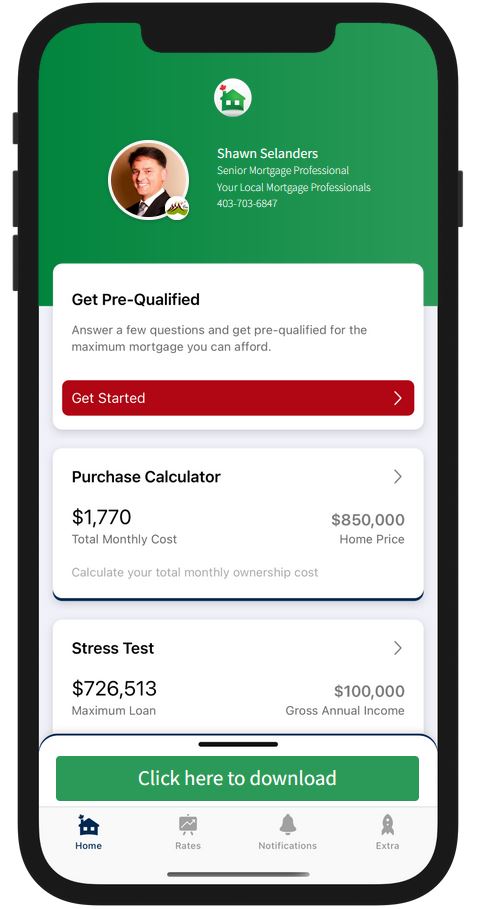
Affordability calculators, real-time rates from 20+ lenders, and the ability to start your application — right from your phone.


Related Guides on My Website
Shawn Selanders — RECA-licensed mortgage broker
Your Local Mortgage Professionals — Independent Mortgage Professional
Serving Calgary, Okotoks, High River, and all of Alberta since 1999
This page is for informational purposes only and does not constitute financial advice. Mortgage approval is subject to lender criteria and conditions. Rates, terms, premium amounts, and programs are subject to change. Insurance premiums shown are approximate. O.A.C. E.&O.E.
📊 Run the Numbers Yourself
Use my free mortgage calculators to estimate payments, closing costs, affordability, and more — before you talk to any lender.
Open Mortgage Calculators →